
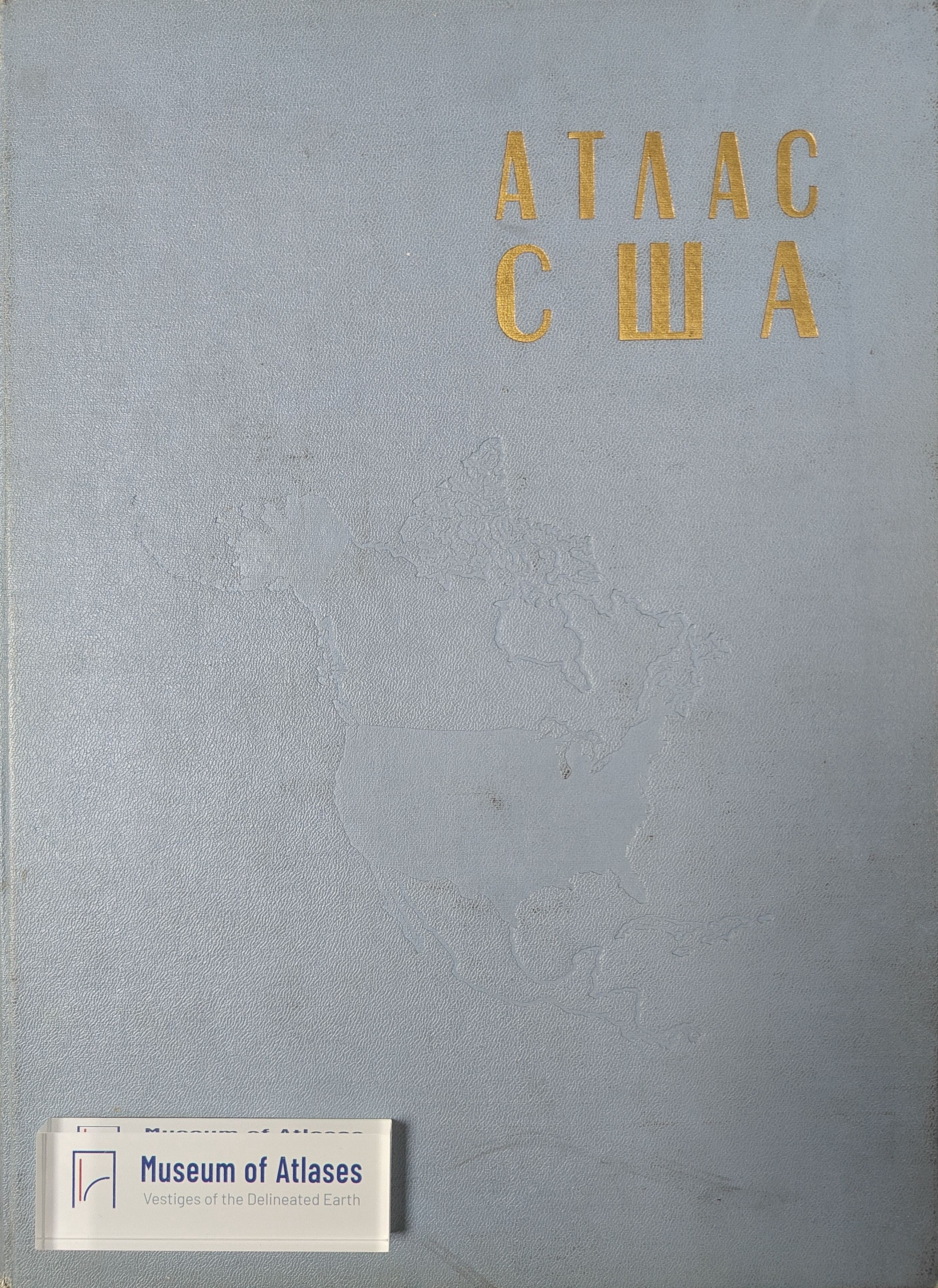
The first Soviet atlas of a capitalist country
Первый советский атлас капиталистической страны
- Publication
- Известия Академии наук СССР. Серия географическая
- Issue
- 6
- Pages
- 125–127
Summary
This article critically reviews the 1966 Atlas of the United States, the first Soviet comprehensive atlas devoted to a capitalist country and the inaugural volume in a planned series on countries and regions of the world. Produced through cooperation between the Main Administration of Geodesy and Cartography, several research institutes, and Moscow State University, the atlas involved more than fifty scholars. The reviewer regards this interdisciplinary model as effective and recommends making such cooperation systematic and formally acknowledging all participating institutions. The atlas is assessed in terms of its structure, source base, thematic coverage, cartographic methods, readability, and suitability as a prototype for subsequent publications. Its seventy-two pages emphasize socioeconomic geography, including population, transport, industry, agriculture, economic regions, foreign economic relations, and statistical reference materials. Drawing mainly on recent American statistics from 1962–1964, with some industrial data from the 1958 census, it offers a detailed yet manageable representation of the spatial organization of the US economy and addresses such significant phenomena as unemployment and immigration. Particular praise is given to innovative maps of population distribution, urbanization, racial geography, employment, freight flows, monopolies, petrochemicals, light industry, agricultural intensity, land use, economic regions, and international trade and finance. Consistent flow scales, concentric symbols, effective use of black for contrast, and supplementary tables and graphs improve both interpretation and informational value. Nevertheless, the review identifies major omissions. The atlas contains too few general geographic maps, provides inadequate treatment of cities and metropolitan structures, and entirely neglects culture, historical geography, and US history. It should have included plans of major urban agglomerations, urban typologies, and maps distinguishing administrative boundaries from actual urbanized areas. Several industrial classifications are also judged insufficiently precise, especially the ambiguous use of “transport engineering” and the representation of aircraft and missile production as a single branch despite their growing technological and territorial separation. Other inconsistencies include uneven historical data for regional industrial structures and the absence of employment change on the manufacturing-output map. Overall, however, the atlas is considered a substantial, modern, accessible, and methodologically important contribution to economic cartography. It successfully serves students, teachers, researchers, institutional specialists, and general readers, supports further study of the United States, and provides a strong technical and organizational model for future Soviet regional and national atlases, provided that later editions broaden their geographic, urban, cultural, and historical coverage and refine selected classifications and statistical presentations.
Comments
Loading...
0/2000