
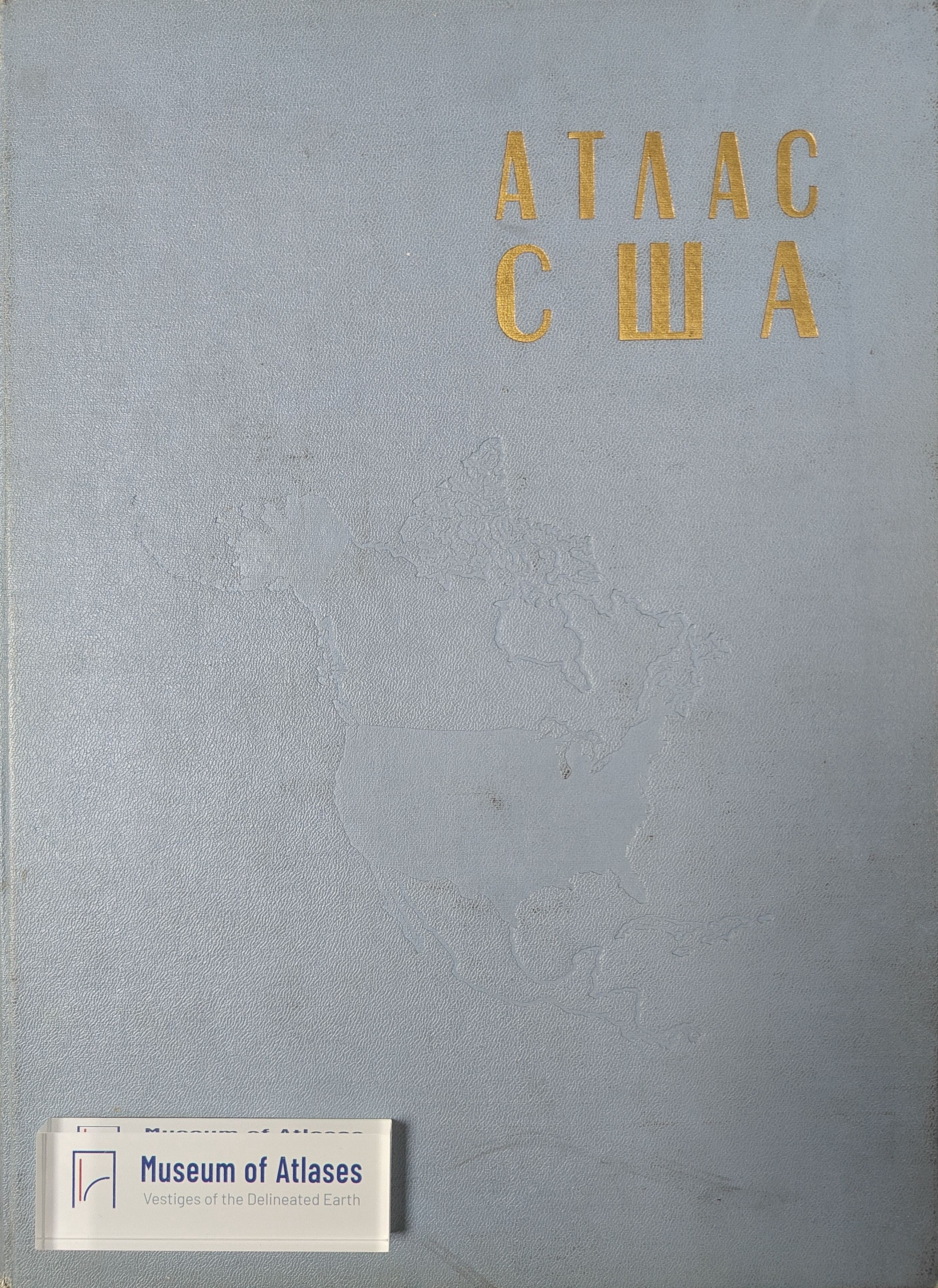
Reviews: Atlas of the United States
Рецензии: Атлас США
- Publication
- Известия Всесоюзного географического общества
- Volume
- 99
- Issue
- 3
- Pages
- 247-250
Summary
This review evaluates the 1966 Soviet Atlas of the United States, the first major economic atlas devoted to an individual foreign country published in the USSR. Of its 59 pages of maps, 42 concern the economy, five population, and nine physical geography. The reviewer assesses the atlas’s cartographic design, thematic coverage, methodological soundness, editorial accuracy, and suitability for different users. Overall, the publication is praised for its high printing quality, clear symbols, appropriate use of choropleth, diagrammatic, and dot-map techniques, and extensive state-level statistics. Its strongest sections are those on industry and agriculture: eighteen industrial maps effectively depict manufacturing structure, energy, oil and gas, while twenty-three agricultural maps provide a broad account of crop and livestock distribution, land use, mechanization, and concentration. Transport and foreign-economic-relations maps are also generally successful. Nevertheless, the review identifies numerous specific weaknesses. Population and transport coverage is too limited; time intervals used for demographic trends are inconsistent; major freight flows are omitted; and some agricultural maps incorrectly represent absolute values by choropleth shading. The map of agricultural specialization contains truncated legend labels and fails to explain the criteria used to define specialization. The attempted mapping of agricultural intensity and capitalist development relies on questionable indicators, excessively precise regional boundaries, and misleading terminology. Regional economic maps largely repeat national-level information, while commodity categories in foreign-trade maps insufficiently distinguish raw materials, semi-finished goods, and finished products. More broadly, explanatory texts and legends suffer from imprecise definitions, ambiguous percentages, terminological errors, and occasional misclassification. The atlas is judged adequate for secondary-school teachers and university students but insufficient for advanced research on the United States. It lacks enough maps of spatial change, detailed large-scale regional insets, comprehensive settlement patterns, regional social and economic differentiation in agriculture, a fuller reference map of populated places, an accurate account of U.S. territorial formation, and examples employing American cartographic conventions. The reviewer concludes that, despite these limitations, the first edition is a valuable teaching and reference resource for detailed study of U.S. economic geography. The proposed revisions are intended both for a future edition and for comparable Soviet atlases of other foreign countries.
Comments
Loading...
0/2000